
By Chimangeni Banda
The rare discovery of Zambia’s largest copper deposits at Mingomba Mine in Chililabombwe District, on the Copperbelt province, demonstrates the significant potency, impact and relevance of technology and artificial intelligence in breaking new frontiers, and pushing social economic activities to unimaginable breakthroughs.
The California, USA based mining firm, Kobold Metals, using artificial intelligence driven cutting edge exploration technology, announced a rare find of an immense high grade copper, in Zambia’s over 100 years of mining.
Largely known globally as a mining nation, Zambia could never have imagined such a discovery with average mineral exploration tools and techniques; yet the deployment of AI changed the country’s copper mining landscape. This exemplifies the use of AI as its accuracy and efficiency pinpointed what conventional methods and techniques had failed or omitted to find. Now, the new US$2 billion Mingomba Mine project is set to change and boost the country’s economic prospects.
Today, the globe has embraced AI as the leading ingredient and factor for economic and societal transformation and advancement, manifesting in rapid economic development, breakthroughs in science, medical research for enhanced health care delivery and application in agriculture for enhanced food security, among others.
Economic schools of thought contend that AI is rapidly transforming global economies and societies by changing how businesses operate, and subsequently increasing countries’ Gross Domestic Product (GDP).
It is such gains that Zambia seeks to benefit from the integration of technology and artificial intelligence in economic activities for maximum exploitation of natural endowments to birth an economic explosion, that citizens would benefit from.
The Global Vibrancy Tool from the Stanford Institute for Human Centred AI shows that the United States of America is the global leader in artificial intelligence investment and consumption, followed by China and the United Kingdom, and a host of other 30 highly ranked countries.
According to an Investopedia publication, the US private sector invested more than US$100 billion in AI in 2024, about 10 times as much as second ranked China, eventually boosting productivity and reshaping labour markets.
According to a Strategic Imperative for Countries and Businesses, Bridging the Chasm Between AI Haves and Have – Nots in the next five years, AI is projected to contribute about US$15.7 trillion to the global economy’s GDP.
India is touted as one of the world’s fastest growing economies and according to PriceWaterhouseCoopers, PwC, AI technology is projected to contribute about US$607 billion to India’s current US$4.125 trillion GDP.
Such visualization is driving Zambia’s own drive for exponential increase in AI investment, usage, and consumption across the social and economic divide, to unlock economic value through technological innovation and enhanced productivity across key sectors of the economy.
Unsatisfied with a US$30 billion economy, President Hakainde Hichilema has set a target of growing Zambia’s economy by exponentially doubling the country’s GDP to US$60 billion by 2031.
An increased GDP would create greater business investment, enhance attractiveness to foreign investors, higher employment and increased revenue base for public services, among others.
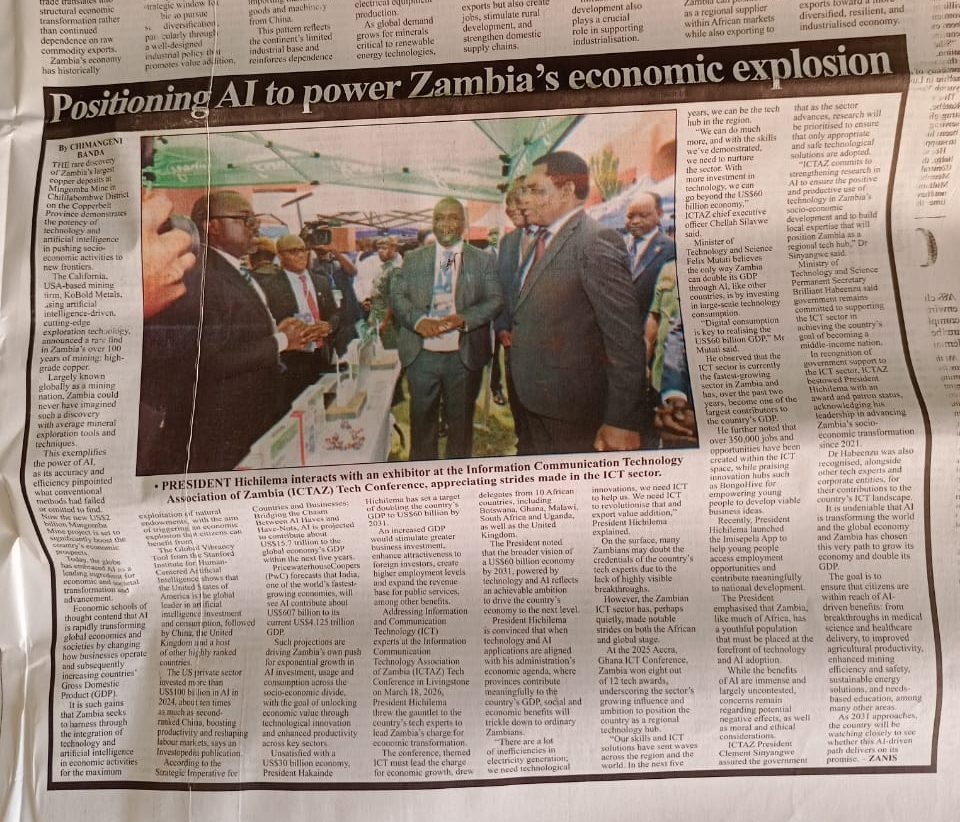
Addressing Information Communication Technology (ICT) experts at the Information Communication Technology Association of Zambia Tech Conference in Livingstone on March 18, 2026, President Hichilema threw the gauntlet to the country’s tech wizards to lead Zambia’s charge for an economic transformation. Themed
“ICT must lead the charge for economic growth” President Hichilema said.
President Hichilema told the delegates that included representatives from 10 African countries among them Botswana, Ghana, Malawi, South Africa, Uganda, including the United Kingdom, that the conference’s theme of “Zambia’s US$60 Billion Economy by 2031; Powered by Technology and AI” was well intentioned and speaks to the achievable desire of driving the country’s economy to the next level.
President Hichilema is convinced that when Technology and AI applications are aligned with his administration’s economic agenda of provinces appropriately contributing to the country’s GDP, social and economic benefits will trickle down to ordinary Zambians.
“There are a lot of inefficiencies in electricity generation, we need technological innovations, we need ICT to help us. We need ICT to revolutionise that, to export value addition” President Hichilema explained.
On face value, many Zambians would doubt the credentials of the country’s tech experts on account of unnoticeable hair raising developments; However, surprisingly, the Zambian ICT sector has made itself noticeable on the Africa and global stage.
At the 2025 Accra, Ghana ICT Conference, Zambia won 8 Tech awards out of 12, justifying the country’s ICT Sector’s push to make Zambia a regional hub for technology.
“Our skills and ICT solutions have sent waves across the region and the world…In the next 5 years, we can be the tech hub in the region. We can do much more, and with the skills we’ve shown, we need to nurture the sector. With more investment in technology, we can go beyond the US$60 billion economy” ICTAZ Chief Executive Officer Chellah Silavwe said.
Minister of Technology and Science Felix Mutati believes the only way Zambia can double her GDP through AI, like other countries across the globe are doing, is by investing in massive technology consumption.
“Digital consumption is key to realising the US$60 billion GDP” Mr Mutati said.
Mr Mutati observed that the ICT sector in Zambia is the fastest growing sector, which in the last two years has been the largest contributor to the country’s GDP.
He pointed out that over 350, 000 jobs and other opportunities have been created in the ICT. He praised Bongo Hive for creating a platform for young people to generate bankable business ideas for operationalization.
Recently, President Hichilema launched the Imisepela App, to help catapult young people to access jobs and other opportunities to change their lives, their communities and contribute to the country’s economic development.
Mr Hichilema shared that like Africa, Zambia’s population is youthful and needs to be put at the frontline of technology and AI application.
While the benefits of technology and AI are immense and incontestable, there are always concerns about negative effects and moral and ethical considerations.
ICTAZ president Clement Sinyangwe assured the government that while the ICT sector is rapidly moving to ensure Zambia becomes a tech hub, research will be undertaken to ensure that only appropriate and non harmful technological solutions are applied and consumed in Zambia.
“ICTAZ commits to strengthen research in AI to ensure positive and productive use of technology in Zambia’s social economic development and build local expertise to position Zambia as a regional tech hub” Dr Sinyangwe shared.
Ministry of Technology and Science permanent secretary Briallian Habeenzu says the government remains committed to supporting the ICT sector to help the country achieve its goal of becoming a middle income country.
“We want to discuss how can we leverage emerging technology including Artificial Intelligence, to leapfrog our productivity in the agricultural sector, we have a target of about 10 million metric tonnes of maize, we have a target of 3 million metric tonnes of copper production, and we also have a target of about US$1 billion in beef export. All these require technology to achieve” Dr Habeenzu explained.
Acknowledging government support to the ICT sector, ICTAZ bestowed President Hichilema with an award and patron status, recognizing his leadership efforts in reshaping Zambia’s social economic strides since 2021.
Technology and Science Permanent Secretary, Dr Habeenzu was equally recognized, along with other tech experts and corporate firms for their trailblazing contributions to the country’s ICT landscape.
It is undeniable that AI is changing the world, changing the global economy; and Zambia has chosen the very path of AI technology application and consumption to grow her economy and double her GDP; to let Zambians be within touching distance of AI benefits; from breakthroughs in science for medical application and healthcare; in agriculture for improved seed variety, livestock and animal disease control, to mining for pinpoint exploration, improved productivity and mining safety; to sustainable cleaner energy generation; and needs based education, among an endless list of beneficiation areas.
When 2031 dawns, the country will anxiously await whether the AI path was worth it, or not? – ZANIS